This meetup is exclusively for the Nansen alumni-community Pockets of Peace. All participants in dialogue courses facilitated by Nansen Center for Peace and Dialogue are encouraged to take part in Pockets of Peace.
What does trust mean to you? What does respect mean to you?
The Nansen Dialogue Approach is deeply rooted in a set of values, ethical foundations, that reflect our ideals being a center for human rights and peace. These valueas are humanity, respect, empathy, trust, equality, non-violence and dignity.
In this Pockets of Peace meetup, we will discover together what these values mean to the Pockets of Peace alumni and how these play out and are possible to practice in the local contexts of the Pockets of peace community.
The meetup is free.
Nansen Training | Dialogue in Conflict | Online
June 8th to Wednesday 10th + June 15th and Tuesday 16th 2026
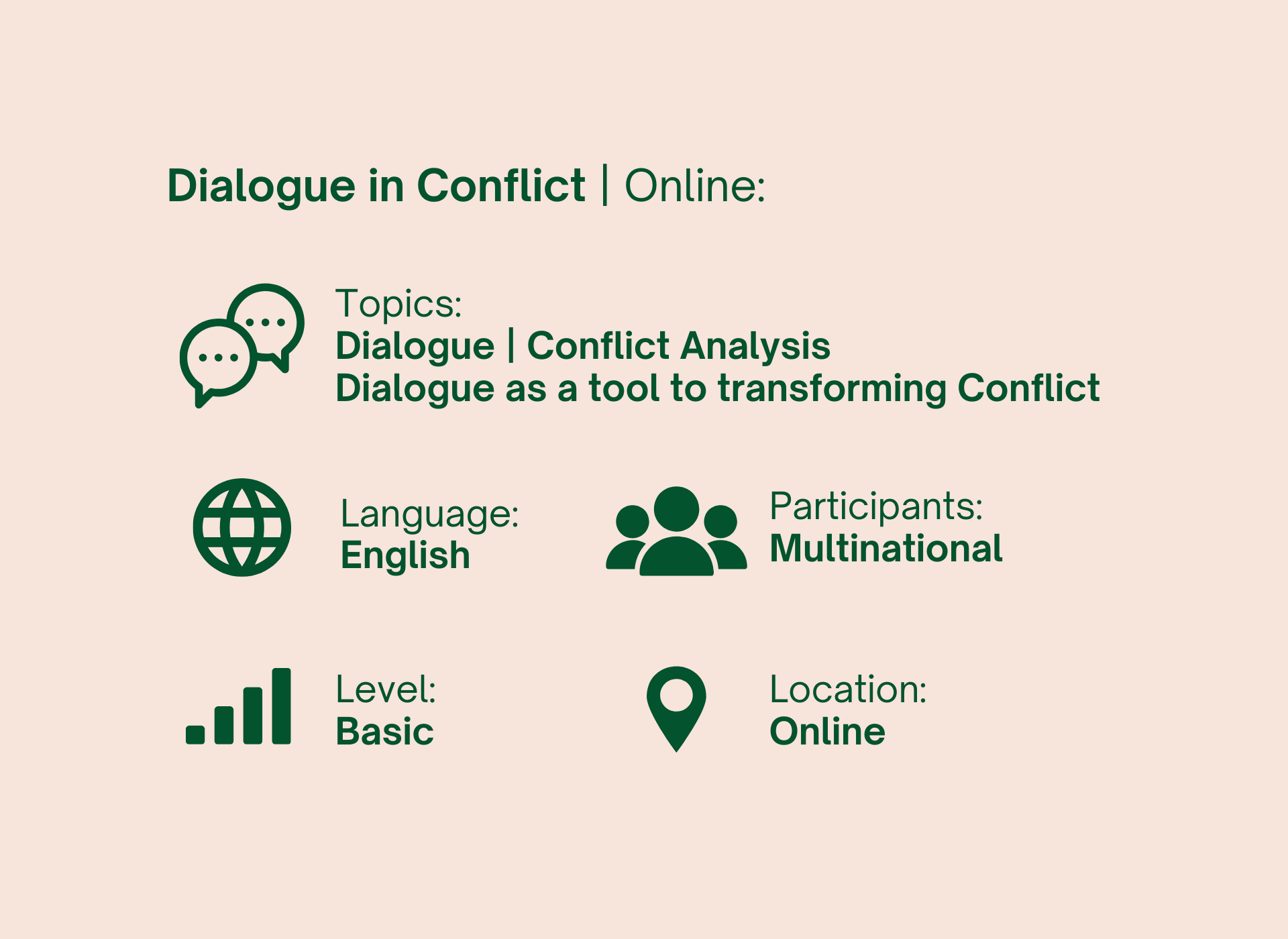
This online training is for you who is interested in exploring the potential of dialogue to transform conflicts into opportunities - online.
«Dialogue in Conflict» is five-day digital process-oriented introductory course. The course addresses topics and introduces tools that can contribute to transforming conflicts. You will improve your dialogue skills, learn conflict mapping and actively use your own life experiences - online.
MAIN COMPONENTS
Identity
Through exercises, you will learn more about yourself and how to build trust in a group. The focus is on the importance of one’s own identity in relation to others.
Introduction to Dialogue
We introduce the Nansen Center for Peace and Dialogue’s approach to dialogue and conflict transformation. Together, we explore the concept of dialogue through exercises where the participants are challenged to reflect on key elements of a dialogue process.
Active Listening and the Art of Asking Good Questions
You are introduced to basic dialogue skills: Active listening, sharing and asking dialogical questions. Through exercises, the participants will experience and develop these skills.
Tools for Conflict Analysis
Conflict analysis is important to understand the complexity of conflict. Based on examples from the participants own experience, we apply four steps in analyzing a conflict:
Identifying challenges, dilemmas and opportunities for change.
Mapping of the actors, their relationships and how they affect each other. This analysis also includes internal and external factors that can affect a conflict situation.
The actor’s positions, interests and needs
Analyzing the roots and effects of the conflict
Online course:
The online course differs from the onsite course in that it is shorter days (5 hours daily, where the onsite is 9 hours daily). While the same themes are touched upon in both courses, the process is deeper between the participants in the onsite course, where the participants also conduct roleplays and try out different forms of facilitation.
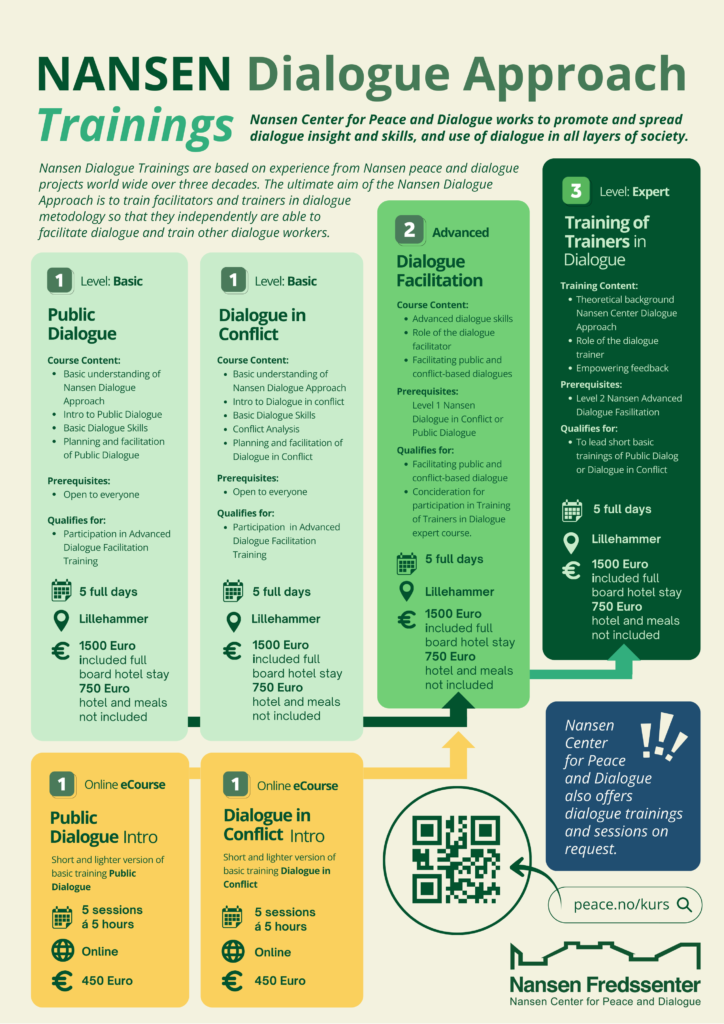
Both the online and the onsite course make participants eligible for the advanced course in Dialogue Facilitation.
Who is the training suitable for?
Participation is open for anyone interested in learning dialogue skills, and how to analyze and transform conflicts.
Dialogue is a way of communicating which aims to deepen and challenge our understanding of ourselves and our relation to “the other”, rather than trying to convince or win with arguments and facts. As dialogue creates space for people´s personal thoughts, emotions, experiences, and world views – it enables us to build and rebuild relationships, as well as becoming better communicators.
Practical information
DURATION: 5 days
DATE: Monday 8th to Wednesday 10th June + Monday 15th + Tuesday 16th June 2026 (5 days in total)
TIME: 11:00–16:00 (CET)
VENUE: Online
LANGUAGE: English
PARTICIPANTS: Max 14 persons
FEE: € 450
APPLICATION DEADLINE: Application deadline: 25th of may
Based on assessment of personal applications and group composition, Nansen Peace Center (NCPD) grants participation in the training. We advice you to apply as soon as you can.
The course does not provide any formal certification. You will receive a document showing proof of completion at the NCPD.
Nansen Training | Public Dialogue | Lillehammer
September 21st - 25th 2026 | Norway
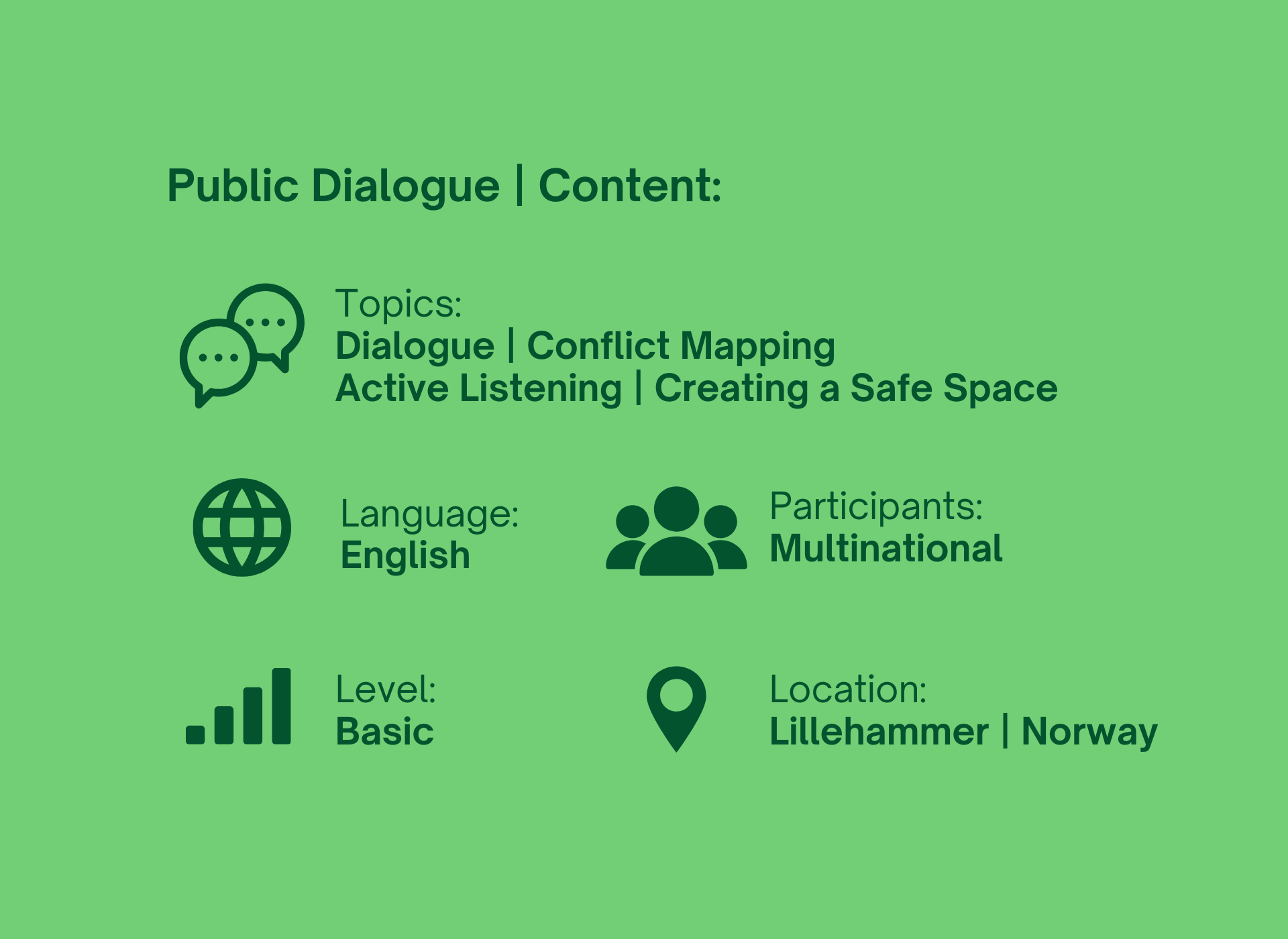
Live at Lillehammer! Training in public dialogue gives insights in how the method can be used to fascilitate and organize public dialogue about sensitive, conflicted or controversial topics in your community or professional practice.
Public dialogue is a facilitated dialogue for citizens about a topic of public interest. It provides a safe – and brave – space to meet, share, listen and reflect, and the approach is particularly useful for addressing sensitive, conflicted, or controversial topics. It can contribute to strengthening communities and their sense of belonging and togetherness despite disagreement.
Public dialogues can contribute to:
- Important conversations connected to happenings, events,conflicts and incidents in a community
- Build and strengthen relationships within communities
- Counter polarization and tensions
- Create inclusive processes and decision-making
- Empower minority voices and people of any background
Knowledge
After the training you will:
- Understand what dialogue and public dialogue are, according to the Nansen Center for Peace and Dialogue.
- Understand how public dialogue can be meaningfully applied in your context or practice.
- Know how to create conditions that enable public dialogue
- Get ideas how dialogue can be used in change processes
- Understand how constructive feedback contributes to learning in a dialogue-based process
Skills
You will train your ability to:
- Ask reflective and dialogical questions
- Support and maintain a space that encourages equitable participation and trust.
- Recognize how your identity, background, and assumptions influence your communication and reactions.
- Stay grounded and multi-partial in complex or emotionally charged situations.
Tools:
In the training you will practice how to:
- Offer and receive constructive feedback as a tool for deepening awareness and learning.
- Formulate open and reflective opening and following up questions
- Listen actively
COURSE COMPONENTS:
1. Dialogue
- Dialogue as a method, perspective, and approach
- Different forms of public dialogue
2. Identity and values:
- Reflect on your identity, values and assumptions, and how these reflect into your reactions in a dialogical space
3. Active Listening and Asking Good Questions
- Practice and insight into active listening
- How listening affects us
- The art of developing and asking opening questions
- The art of asking follow-up questions
4. Creating a Safe Space
- Practical exercise in facilitating public dialogues
- What is a safe, brave and dialogical space?
- How to create a safe, brave and dialogical space
- Introduction to the role of the facilitators and their responsibilities
Who is the training suitable for?
Anyone who wants to organize inclusive and dialogical public conversations – in a neighborhood, at the workplace, or to highlight important conversations in local communities. This course is structured so that each participant can use the given tools and exercises afterwards, both privately and professionally.
Practical information
DURATION: 5 full days
DATE: September 21st - 25th 2026 (advised arrival on the 5th)
VENUE: Scandic Victoria Hotel, Lillehammer, Norway
TIME: 09:00–18:00 (CET)
LANGUAGE: English
PARTICIPANTS: Max 14 persons
FEE:
- Full board: EUR 1500 (included all meals and accomodation)
- Training: EUR 800 (included lunch - but requires participants to book own accomodation).
APPLICATION DEADLINE: August 10th 2026. Apply sooner if you need visa.
Based on assessment of personal applications and group composition, Nansen Peace Center grants participation in the training. We advice you to apply as soon as you can.
Seats are allocated continuously, so we advice you to apply as soon as you can.
PARTICIPATING in this course will make you eligible to the advanced trainings in dialogue facilitation.
Nansen Training | Public Dialogue | Online Course
November 2nd - 4th & November 9th – 10th 2026.
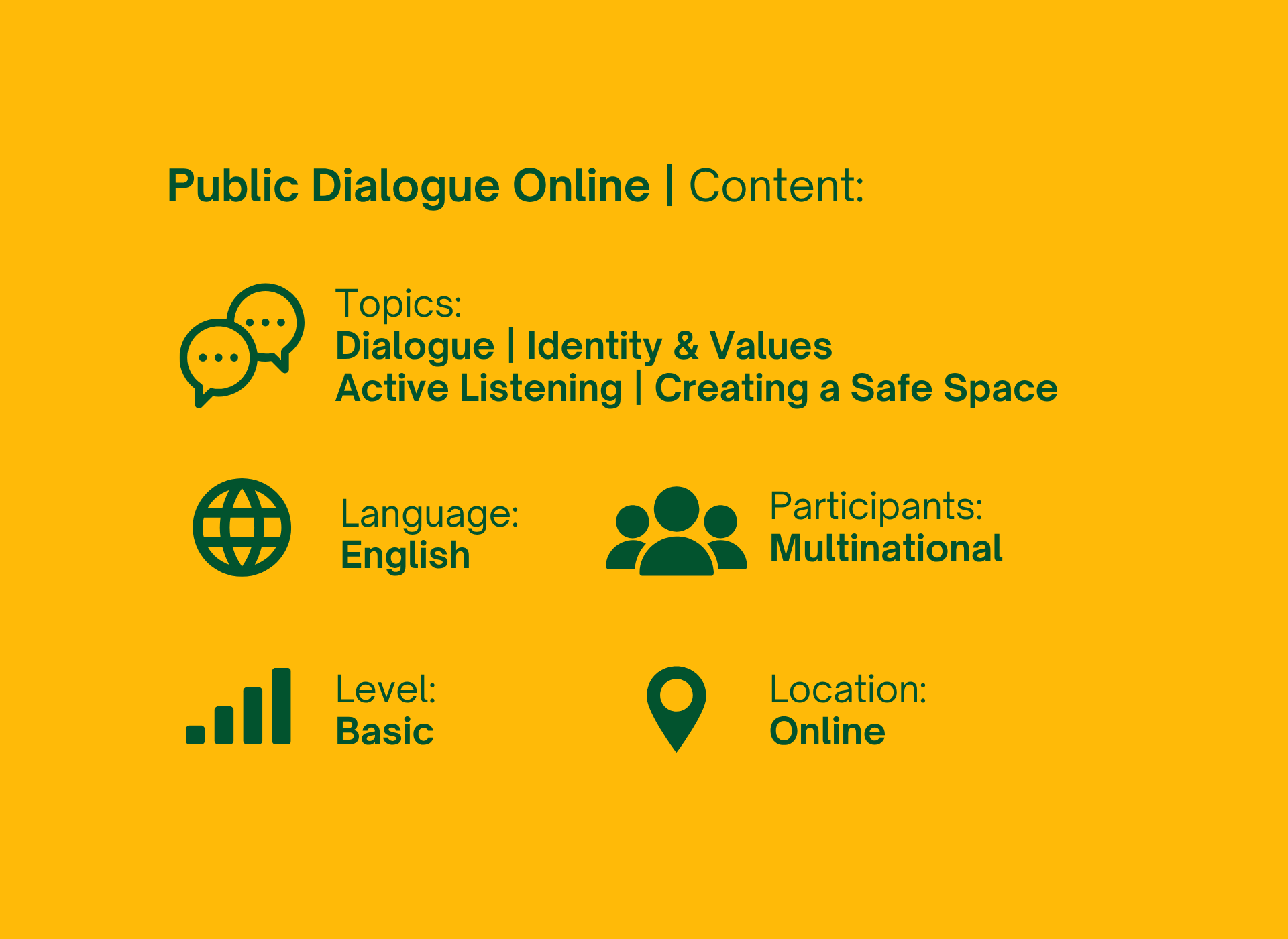
Basic introduction to public dialogue - online! Get insights in how the method can be used to fascilitate and organize public dialogue about sensitive, conflicted or controversial topics in your community or professional practice.
Public dialogue is a facilitated dialogue for citizens about a topic of public interest. It provides a safe – and brave - space to meet, share, listen and reflect, and the approach is particularly useful for addressing sensitive, conflicted, or controversial topics. It can contribute to strengthening communities and their sense of belonging and togetherness despite disagreement.
Public dialogues can contribute to:
- Important conversations connected to happenings, events,conflicts and incidents in a community
- Build and strengthen relationships within communities
- Counter polarization and tensions
- Create inclusive processes and decision-making
- Empower minority voices and people of any background
Knowledge
After the training you will:
- Understand what dialogue and public dialogue are, according to the Nansen Center for Peace and Dialogue.
- Understand how public dialogue can be meaningfully applied in your context or practice.
- Know how to create conditions that enable public dialogue
- Get ideas how dialogue can be used in change processes
- Understand how constructive feedback contributes to learning in a dialogue-based process
Skills
You will train your ability to;
- Ask reflective and dialogical questions
- Support and maintain a space that encourages equitable participation and trust.
- Recognize how your identity, background, and assumptions influence your communication and reactions.
- Stay grounded and multi-partial in complex or emotionally charged situations.
Tools:
In the training you will practice how to
- Offer and receive constructive feedback as a tool for deepening awareness and learning.
- Formulate open and reflective opening and following up questions
- Listen actively
COURSE COMPONENTS:
1. Dialogue
- Dialogue as a method, perspective, and approach
- Different forms of public dialogue
2. Identity and values:
- Reflect on your identity, values and assumptions, and how these reflect into your reactions in a dialogical space
3. Active Listening and Asking Good Questions
- Practice and insight into active listening
- How listening affects us
- The art of developing and asking opening questions
- The art of asking follow-up questions
4. Creating a Safe Space
- What is a safe, brave and dialogical space?
- How to create a safe, brave and dialogical space
- Introduction to the role of the facilitators and their responsibilities
- Practical exercise in facilitating public dialogues
Who is the training suitable for?
Anyone who wants to organize inclusive and dialogical public conversations – in a neighborhood, at the workplace, or to highlight important conversations in local communities. This course is structured so that each participant can use the given tools and exercises afterwards, both privately and professionally.
Read more about Nansen Dialogue Approach.
Practical information
DURATION: 5 days | 5 hours per day
DATE: November 2nd - 4th and November 9th – 10th 2026
TIME: 11:00–16:00 (CET)
LANGUAGE: English
PARTICIPANTS: Max 14 persons
FEE: EUR 450
APPLICATION DEADLINE: October 25th.
Based on assessment of personal applications and group composition, Nansen Peace Center grants participation in the training. We advice you to apply as soon as you can.
The course does not provide any formal certification, but you will receive a document showing proof of completion at the NCPD.
PARTICIPATING in this course will make you eligible to the advanced trainings in dialogue facilitation.
DIALOGUE is a facilitated conversation based on active listening and explorative questions.
PUBLIC DIALOGUE is a facilitated dialogue for citizens about a topic of public interest. It provides a safe – and brave - space to meet, share, listen and reflect, and the approach is particularly useful for addressing sensitive, conflicted, or controversial topics. It can contribute to strengthening communities and their sense of belonging and togetherness despite disagreement.
Nansen Training | Dialogue in Conflict | Lillehammer
March 16th - 20th 2026 | Norway
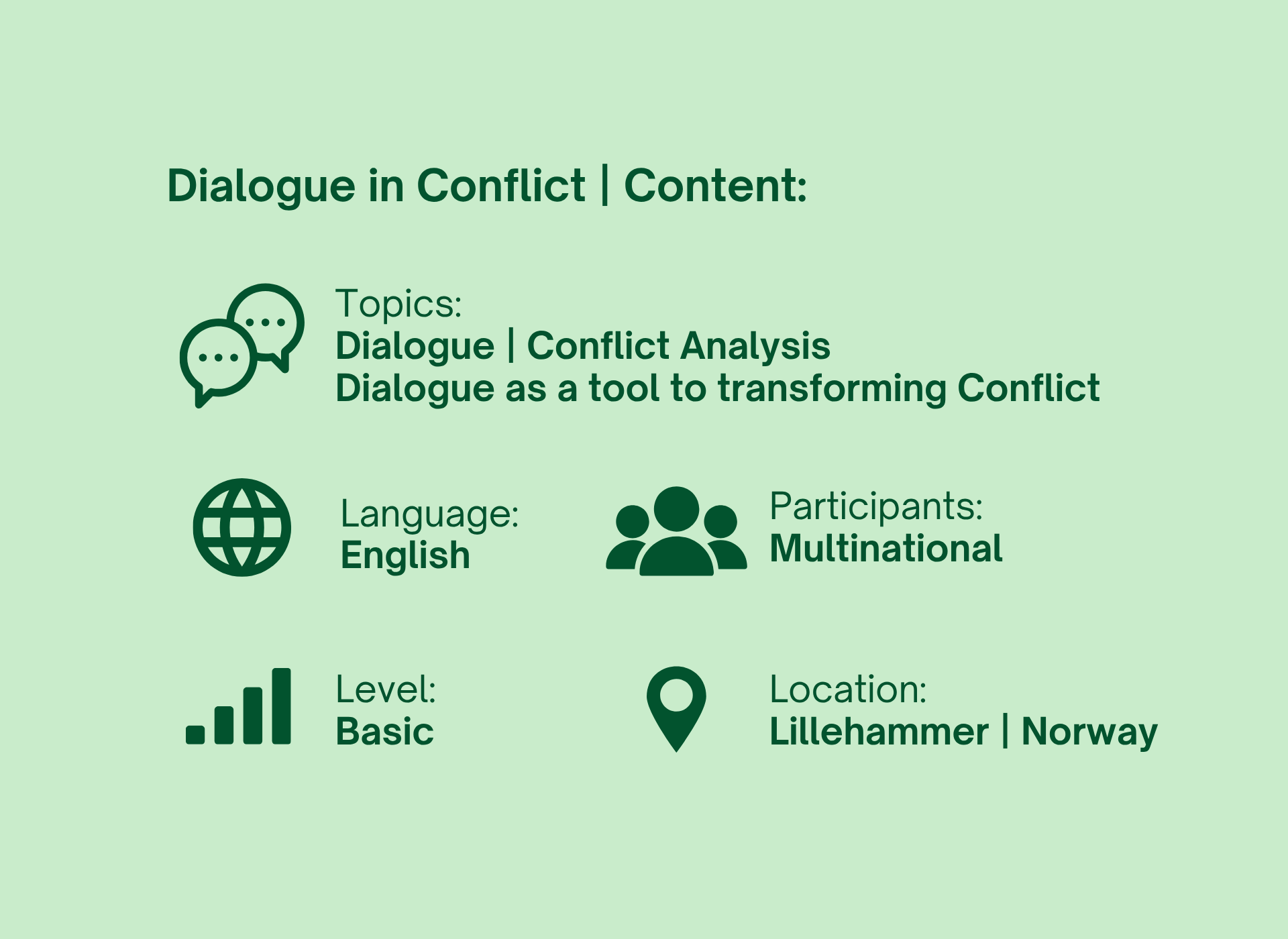
This training is for you who is interested in exploring the potential of dialogue to transform conflicts into opportunities.
«Dialogue in Conflict» is an introductory course, addressing topics and introducing tools that can contribute to transforming conflicts.You will improve your dialogue skills, learn conflict mapping and be introduced to dialogue facilitation in conflict situations. This is a five-day process-oriented course with a series of activities where the participants actively use their own life experiences.
MAIN COMPONENTS
Identity
Through exercises, you will learn more about yourself and how to build trust in a group. The focus is on the importance of one’s own identity in relation to others.
Introduction to Dialogue
We introduce the Nansen Center for Peace and Dialogue’s approach to dialogue and conflict transformation. Together, we explore the concept of dialogue through exercises where the participants are challenged to reflect on key elements of a dialogue process.
Active Listening and the Art of Asking Good Questions
We are introduced to basic dialogue skills: Active listening, sharing and asking dialogical questions. Through exercises, the participants will experience and develop these skills.
Tools for Conflict Analysis
Conflict analysis is important to understand the complexity of conflict Based on examples from the participants own experience, we apply four steps in analyzing a conflict:
- Mapping of the actors, their relationships and how they affect each other. This analysis also includes internal and external factors that can affect a conflict situation.
- The actor’s positions, interests and needs
- Analyzing the roots and effects of the conflict
- Identifying challenges, dilemmas and opportunities for change
Dialogue facilitation as a Tool for Transforming Conflict
We introduce and reflect on the role of dialogue facilitation in a process of conflict transformation.
Role of the Facilitator
Brief introduction to the role of a dialogue facilitator. Some participants will also have the opportunity to facilitate dialogue through role play.
Facilitating dialogue in role play
Based on conflicts mapped and analyzed by participants we make use of role play for practicing dialogue facilitation. This provides for learning through practice, including how to give and receive feedback.
Who is the training suitable for?
Participation is open for anyone interested in learning dialogue skills, and how to analyze and transform conflicts.
Dialogue is a way of communicating which aims to deepen and challenge our understanding of ourselves and our relation to “the other”, rather than trying to convince or win with arguments and facts. As dialogue creates space for people´s personal thoughts, emotions, experiences, and world views – it enables us to build and rebuild relationships, as well as becoming better communicators.
Read more about Nansen Dialogue Approach
Practical information
DURATION: 5 full days
DATE: March 16th - 20th 2026 (advised arrival on the 15th)
TIME: 09:00–18:00 (CET)
VENUE: Scandic Victoria Hotel Lillehammer
LANGUAGE: English
PARTICIPANTS: Max 14 persons
FEE:
- Full board: € 1500 (included all meals and accomodation)
- Training: € 750 (included lunch - but requires participants to book own accomodation).
APPLICATION DEADLINE: February 2nd 2026. Apply sooner if you need visa.
Based on assessment of personal applications and group composition, Nansen Peace Center grants participation in the training. We advice you to apply as soon as you can.
The course does not provide any formal certification, but you will receive a document showing proof of completion at the NCPD.
Nansen Training | Advanced Dialogue Facilitation | Lillehammer
November 30th - December 4th 2026 | Norway

Do you want to learn how to organize and facilitate dialogue processes in different contexts? Like conflict situations, challenging topics or for building or re-building social networks? This is the training for you.
Dialogue facilitation is an approach in conflict transformation and community building which enable people to talk together in an honest, open, and humanizing manner. Participants are invited to a process-based way of talking, where empathic listening and good questions form the foundation, and inclusiveness, respect, joint ownership, and humanity are the key ingredients. The facilitator of this process is crucial for creating and maintaining a safe space where participants feel respected, heard, and valued.
COURSE CONTENT:
This is a five-day interactive course that addresses various aspects of the facilitator’s role. The goal of this training is that you afterwards feel competent to facilitate a dialogue session either dialogue in conflict or public dialogue.
You will practice and reflect on the role of the facilitator and talk about challenges and dilemmas you might encounter when you practice the role in your context.
The conclusion of the training program implies the planning and implementation of a dialogue session on your working place or in connection with your volunteer work and an online final closing session.
MAIN COMPONENTS IN TRAINING:
Review: What Is a Dialogue?
You review various ways of understanding dialogue, as well as the most important elements in our approach. You will also recap your knowledge of asking dialogical questions and active listening.
Reflection: Activity
You will reflect on what dialogue facilitation is, and how does it differ from mediation, moderation and negotiation.
Understanding: Role of the Facilitator
What is the role of the facilitator in a conflict based or public dialogue? Which personal qualities and abilities must you have as a facilitator? Go through the essential tools in a facilitator’s dialogic toolbox.
Exercise: Dialogue Facilitation
You will practice dialogue facilitation in situations with different challenges using role play based on different themes and conflict situations. Then, you will receive feedback from both the course leaders and the other participants. These practices will help you and others to get more comfortable in the role, learn to give and receive feedback and understand your own strengths and weaknesses in that role.
Dilemmas: Related to Facilitation
You will reflect on dilemmas related to the facilitator’s role, including the power balance, emotional outbursts, and elements that can hinder a good dialogue. What do you do when there is no right or wrong answer. The course will also focus on how you can stay multi-partial, so that all participants can trust the process and feel safe and brave enough to participate. You will also reflect on how to be an authority without being authoritarian.
Preparing: A Dialogue Process
Facilitation of dialogues needs to be prepared. You will learn about various steps in this planning process, among others recruitment. We also take a closer look at conflict as a transformative process and how to plan it and where and when to use public dialogues in your communities.
DIALOGUE is a facilitated conversation based on active listening and explorative questions.
Who is the facilitator training suitable for?
Anyone who has participated on basic level dialogue courses offered through Nansen Center for Peace and Dialogue - or similar qualifications.
Read more about Nansen Dialogue Approach
Practical information
DURATION: 5 full days
DATE: November 30th – December 4th 2026 (advised arrival on November 29th)
VENUE: Nansen Center for Peace and Dialogue, Lillehammer, Norway
TIME: 09:00–18:00 (CET)
LANGUAGE: English
PARTICIPANTS: Max 14 persons
FEE:
- Full board: € 1500 (included all meals and accomodation)
- Training: € 750 (included lunch - but requires participants to book own accomodation).
APPLICATION DEADLINE: October 19th 2026. Apply sooner if you need visa.
Based on assessment of personal applications and group composition, Nansen Peace Center grants participation in the training. We advice you to apply as soon as you can.
The course does not provide any formal certification, but you will receive a document showing proof of completion at the NCPD.
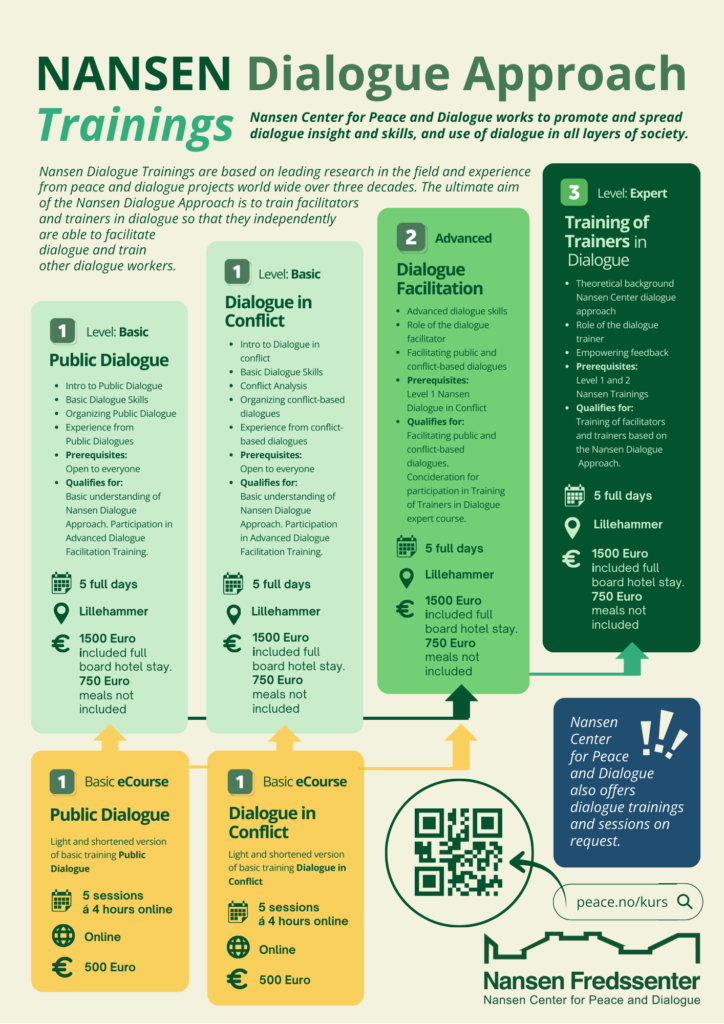
Pockets of Peace Alumni Gathering 2027
Lillehammer June 2027 | Date to be decided
Plans are yet to be made – but save the month: For three days in June 2027, we invite all members of the Pockets of Peace Alumni and other participants with dialogue qualfications to Nansen Center for Peace and Dialogue at Lillehammer.
Expect three days of conversations, sharing of experiences and reflections. Themes are to be announced – but for now: Start the countdown!
Online alumni gathering May 2026
All members of the Pockets of Peace alumni are invited to our online Pockets of Peace pregathering at May 20th - 21st 2026. Participation on the online gathering is free, programme and registration at: peace.no/pockets2026/
Background
Pockets of Peace is the name of the alumni network/community of the Nansen Center for Peace and Dialogue (NCPD).
Our vision is to develop the network as a thriving meeting place, where contact is created and maintained. A community where experiences are exchanged and where participants can get professional replenishment, material and inspiration, opportunities for guidance and sparring with peers.
Pockets of Peace is also a meeting place for dialogue news, events, positions, where new courses can be recruited and where fertile ground can be established for potential new collaborations; both between NCDP and partners and internally in the alumni network.
The alumni network has been named Pockets of Peace because we believe dialogue exists in "pockets of peace". These pockets of peace can be found among people, cultures and meeting places all over the world. The goal of the alumni network is to gather small and large pockets of peace in the world into a larger community. Together, we can also expand these pockets of peace.
Members
To become a member of the network, members must have attended at least a course or seminar equivalent to NCPD's basic course in dialogue and conflict transformation
PS: Sign up for Pockets og Peace at POCKETS OF PEACE – NCPD Alumni Network