
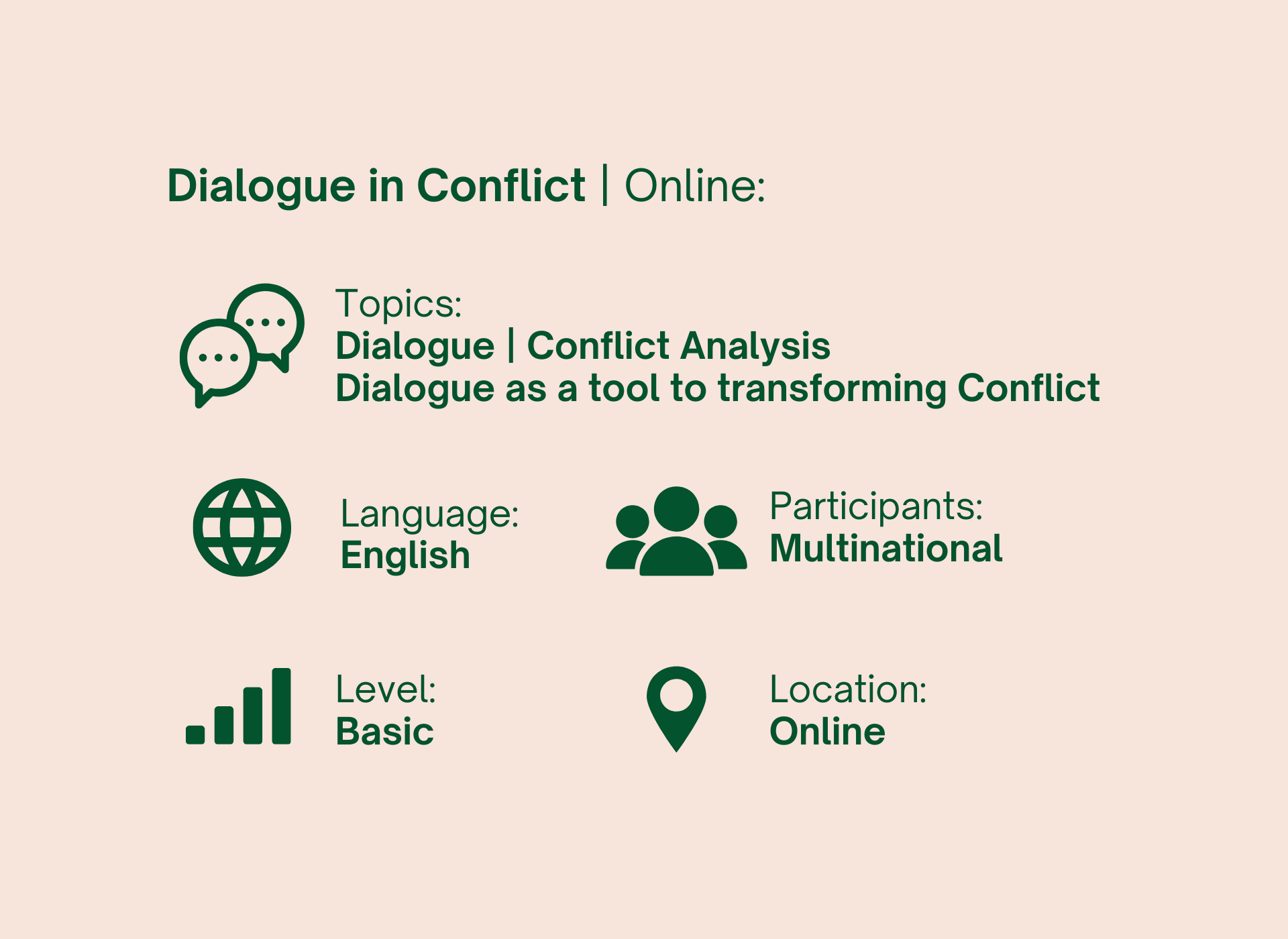
This online training is for you who is interested in exploring the potential of dialogue to transform conflicts into opportunities - online.
«Dialogue in Conflict» is five-day digital process-oriented introductory course. The course addresses topics and introduces tools that can contribute to transforming conflicts. You will improve your dialogue skills, learn conflict mapping and actively use your own life experiences - online.
MAIN COMPONENTS
Identity
Through exercises, you will learn more about yourself and how to build trust in a group. The focus is on the importance of one’s own identity in relation to others.
Introduction to Dialogue
We introduce the Nansen Center for Peace and Dialogue’s approach to dialogue and conflict transformation. Together, we explore the concept of dialogue through exercises where the participants are challenged to reflect on key elements of a dialogue process.
Active Listening and the Art of Asking Good Questions
You are introduced to basic dialogue skills: Active listening, sharing and asking dialogical questions. Through exercises, the participants will experience and develop these skills.
Tools for Conflict Analysis
Conflict analysis is important to understand the complexity of conflict. Based on examples from the participants own experience, we apply four steps in analyzing a conflict:
Identifying challenges, dilemmas and opportunities for change.
Mapping of the actors, their relationships and how they affect each other. This analysis also includes internal and external factors that can affect a conflict situation.
The actor’s positions, interests and needs
Analyzing the roots and effects of the conflict
Online course:
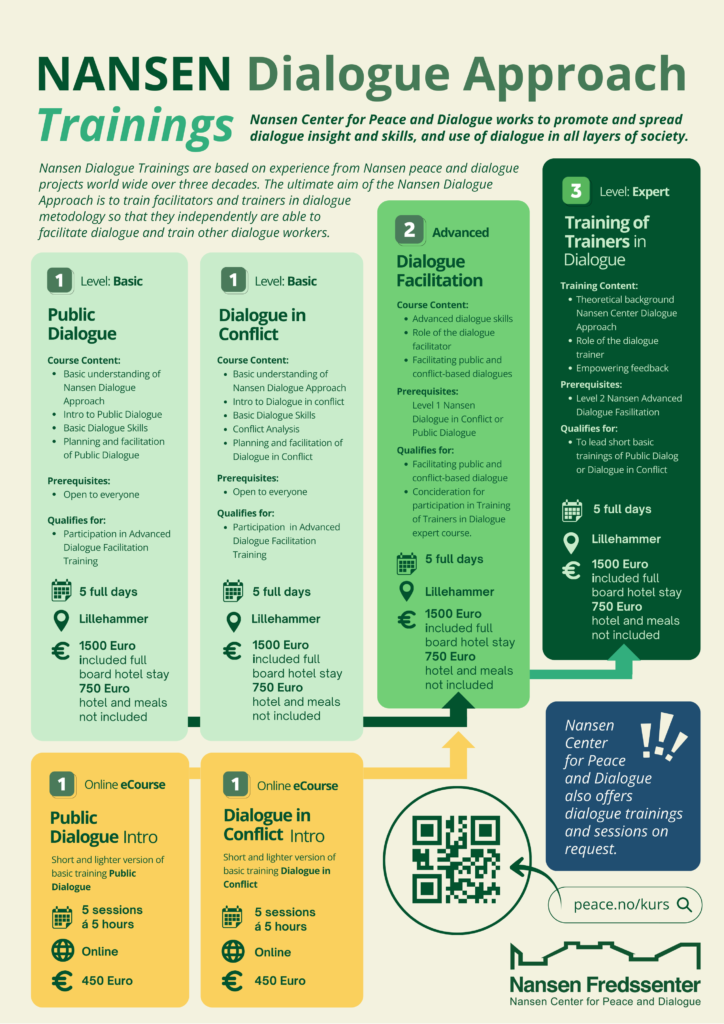
The online course differs from the onsite course in that it is shorter days (5 hours daily, where the onsite is 9 hours daily). While the same themes are touched upon in both courses, the process is deeper between the participants in the onsite course, where the participants also conduct roleplays and try out different forms of facilitation.
Both the online and the onsite course make participants eligible for the advanced course in Dialogue Facilitation.
Who is the training suitable for?
Participation is open for anyone interested in learning dialogue skills, and how to analyze and transform conflicts.
Dialogue is a way of communicating which aims to deepen and challenge our understanding of ourselves and our relation to “the other”, rather than trying to convince or win with arguments and facts. As dialogue creates space for people´s personal thoughts, emotions, experiences, and world views – it enables us to build and rebuild relationships, as well as becoming better communicators.
Practical information
DURATION: 5 days
DATE: Monday 8th to Wednesday 10th June + Monday 15th + Tuesday 16th June 2026 (5 days in total)
TIME: 11:00–16:00 (CET)
VENUE: Online
LANGUAGE: English
PARTICIPANTS: Max 14 persons
FEE: € 450
APPLICATION DEADLINE: Application deadline: 25th of may
Based on assessment of personal applications and group composition, Nansen Peace Center (NCPD) grants participation in the training. We advice you to apply as soon as you can.
The course does not provide any formal certification. You will receive a document showing proof of completion at the NCPD.
Dialogue project Chile
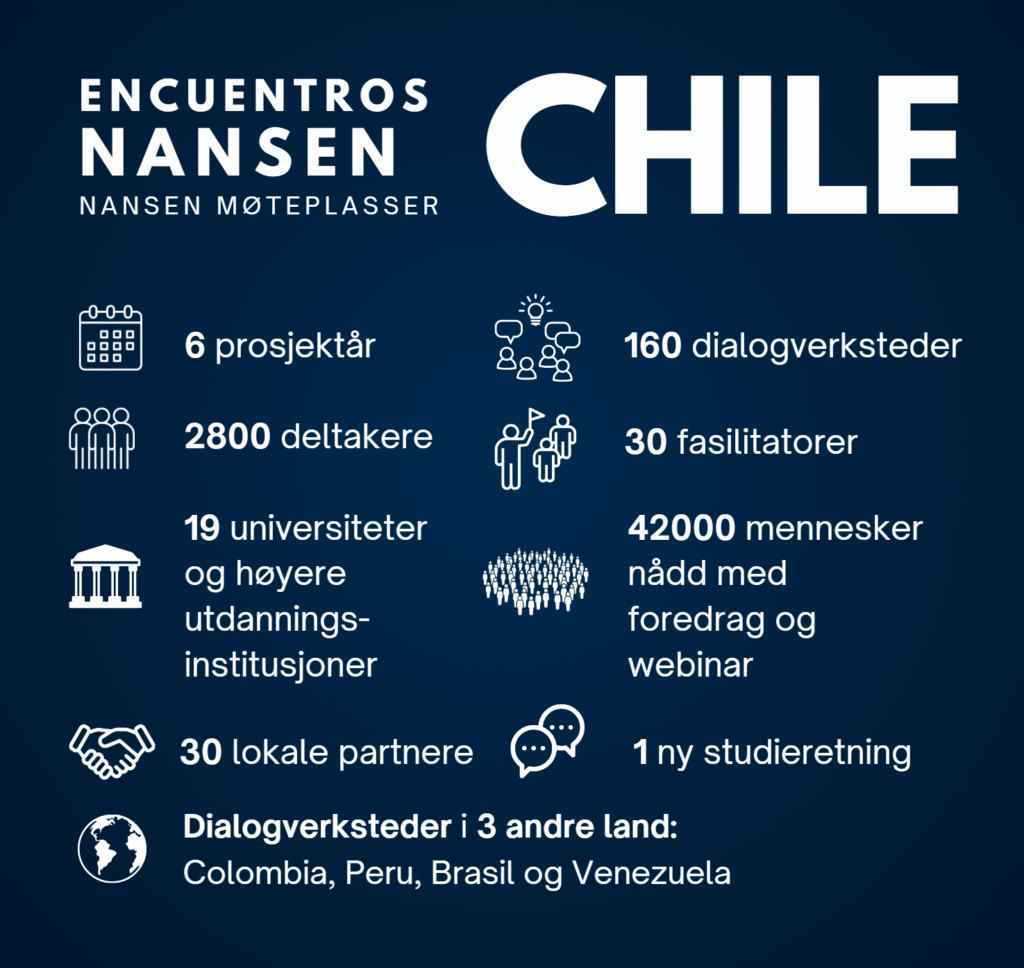
The Dialogue Project in Chile began in October 2019, at the request of then-President Sebastián Piñera. It was later renewed by the current President Gabriel Boric. The work is funded by the Ministry of Foreign Affairs and carried out in close collaboration with over 30 local partners, including 19 universities.
The project has conducted more than 500 dialogue activities in Chile, with over 40,000 participants, 30 local partners, a handbook translated into Spanish and Mapudungun, and a solid effort from a dedicated team in Chile under the leadership of project manager Alfredo Zamudio.
The work in Chile has had two main components:
1) National: Encuentros Nansen, a dialogue process that began during the unrest in October 2019, with 31 confidential conversations between the government, civil society, academia, students, and the private sector.
2) Regional: The work continued following a request from seven universities in Araucanía (the Mapuche area) in southern Chile, which led to 81 dialogue workshops with over 1,400 participants in Araucanía. In addition, a further 80 workshops have been conducted in other parts of the country, with a total of 2,800 people participating.
In addition to these 160 basic workshops, the project has conducted a workshop in facilitation. The project has also collaborated with 10 institutions in Colombia, Brazil, and Peru, including universities, civil society, and national institutions, and has carried out physical workshops, in addition to webinars for several other countries in the region, including Venezuela.
Findings and Further Dialogue Work
The team in Chile has documented all the work along the way, including a report on the work with Encuentros Nansen.
The team in Chile has conducted a study on the impact of the capacity-building work, with a larger survey of around 600 responses. The study is to be published in December and will be shared with some of our key partners. It is especially noted that 94% of participants have used one or more dialogue tools they learned in the course and have encountered two major obstacles:
- Resistance to change (74%)
- Lack of time (62%)
Trust – the Critical Infrastructure
To generate the necessary changes, three pillars are required: knowledge, institutions, and will. In Chile, we have institutions and a great deal of knowledge, but in some cases, the will is scattered or absent.


Just as roads, hospitals, water systems, and communication networks are critical infrastructures that guarantee human well-being, trust is the critical infrastructure that enables collaboration between institutions and people. Sometimes, trust also acts as a social and emotional engine, seeking to find hope where it may not be immediately visible.
The critical infrastructure
We need to recognize that trust is a critical infrastructure, indispensable for institutions to function and to address today’s and tomorrow’s problems. The World Economic Forum, in a recent “Future of Jobs Report,” states that the world is facing multiple complex crises—or “polycrises”—and that immediate societal changes are needed to tackle them. People don’t just need to know things to do their jobs; they must also be able to adapt when everything changes, when mistakes are made, or when it’s time to start over. Trust is the sum of emotions that allows us to live without fear.
We all understand the importance of the structures that support our societies, but we don’t always see how deeply interconnected they are and how much they rely on information, collaboration, and trust. Protocols, controls, sanctions, and limits can be created, but a regulatory system on its own cannot enable everyone to collaborate at their full potential. A frightened society cannot be innovative, because it doesn’t dare to explore new paths.
Three pillars of change
To generate the necessary changes, three pillars are required: knowledge, institutions, and will. In Chile, we have institutions and a great deal of knowledge, but in some cases, the will is scattered or absent. Sometimes, what we need is not more diagnostics, but the courage to ask: if we know so much, why don’t we do what needs to be done? A big part of the answer has to do with the lack of trust and collaboration between institutions.
People often ask us, “What’s the point of dialogue if we don’t see immediate results?” They’re a bit disappointed when we explain that a dialogue process is not quick—it follows its own rhythm. Rushing doesn’t always lead to results. “I don’t need answers—I need you to listen,” is something we frequently hear between groups with different points of view. Taking the time to engage in dialogue is an investment in that invisible fabric that sustains collaboration.
Who should we be listening to?
How can we transform this archipelago of distant people into a more collaborative, more humane, more inclusive country? There’s no doubt we need urgent solutions to problems like corruption, crime, poverty, and others. While it may be tempting to tell your own group that from your shore you can see the whole picture—and that other perspectives don’t matter—none of these islands hold all the answers. When you don’t know the path, it is wise to ask: Where do we want to go, and who should we be listening to?
It’s not easy, but it is possible to build with those who have different pasts. It always starts with some point of connection. “I never thought I’d find myself with someone like you,” we’ve heard in the dialogue workshops we’ve held across the country - and sometimes, there’s an embrace where just before there were opposing sides. Hope lives in those emotions.
Seeking common ground
It’s not about all agreeing - our diversity means we experience life in different ways - but what if we built a “community of disagreements,” where thinking differently doesn’t frighten us, and where keeping our differences isn’t the same as living in separate worlds? To put it simply: not all of us support the same football team, but we can agree it’s a beautiful sport.
From the ashes of the most devastating crises, ideas for peace can blossom. One example is the Treaty of Paris, signed in April 1951, which created the European Coal and Steel Community. Among its signatories were the Federal Republic of Germany and France. The Second World War had ended just six years earlier. The pain had not been forgotten; it was still present when they signed an agreement that changed the course of Europe.
Encounter, not confrontation
The challenges we face are not in the distant future - they’re knocking on the door right now. There is real fear, deep fatigue, and yet we know that within many hearts lives the stubborn hope that we can listen to one another, and that things can get better. Every generation has its turning point, and preparing for peace is an inevitable step. Amid these tectonic shifts, with declining trust in democracy, this is a good moment to ask: Do we keep going as we are, or do we do something different?
We sometimes forget that many of the most lasting solutions don’t come from confrontation, but from encounter. As Mahatma Gandhi said: “The best way to resolve any political or social issue is for the protagonists of opposing views to meet and speak with sincerity and honesty.” Just as we invest in traditional infrastructures, it may be truly visionary to ask: What would happen if we multiplied spaces for dialogue and became a more dialogic society?
In Chile, we need to create a permanent meeting point—a reference for dialogue and trust—and why not, one with a regional outlook as well. The urgency is clear. Preparing for peace must be a state policy. It is an inevitable step.
---
Alfredo Zamudio is the director of the mission in Chile at the Nansen Center for Peace and Dialogue.
This is a translation of the original article published in El País, on July 18, 2025. The original Spanish version can be found here: https://elpais.com/chile/2025-07-18/la-infraestructura-critica.html
---
Read more about the Dialogue project in Chile
Pockets of Peace Alumni Gathering 2027
Lillehammer June 2027 | Date to be decided
Plans are yet to be made – but save the month: For three days in June 2027, we invite all members of the Pockets of Peace Alumni and other participants with dialogue qualfications to Nansen Center for Peace and Dialogue at Lillehammer.
Expect three days of conversations, sharing of experiences and reflections. Themes are to be announced – but for now: Start the countdown!
Online alumni gathering May 2026
All members of the Pockets of Peace alumni are invited to our online Pockets of Peace pregathering at May 20th - 21st 2026. Participation on the online gathering is free, programme and registration at: peace.no/pockets2026/
Background
Pockets of Peace is the name of the alumni network/community of the Nansen Center for Peace and Dialogue (NCPD).
Our vision is to develop the network as a thriving meeting place, where contact is created and maintained. A community where experiences are exchanged and where participants can get professional replenishment, material and inspiration, opportunities for guidance and sparring with peers.
Pockets of Peace is also a meeting place for dialogue news, events, positions, where new courses can be recruited and where fertile ground can be established for potential new collaborations; both between NCDP and partners and internally in the alumni network.
The alumni network has been named Pockets of Peace because we believe dialogue exists in "pockets of peace". These pockets of peace can be found among people, cultures and meeting places all over the world. The goal of the alumni network is to gather small and large pockets of peace in the world into a larger community. Together, we can also expand these pockets of peace.
Members
To become a member of the network, members must have attended at least a course or seminar equivalent to NCPD's basic course in dialogue and conflict transformation
PS: Sign up for Pockets og Peace at POCKETS OF PEACE – NCPD Alumni Network
Afghanistan must not be isolated – It is time for Dialogue and Diplomacy
Nansen Center for Peace and Dialogue urges Norway and the international community to remain committed to the people of Afghanistan and keep lines of communication open.
By Norunn Grande, Director NCPD
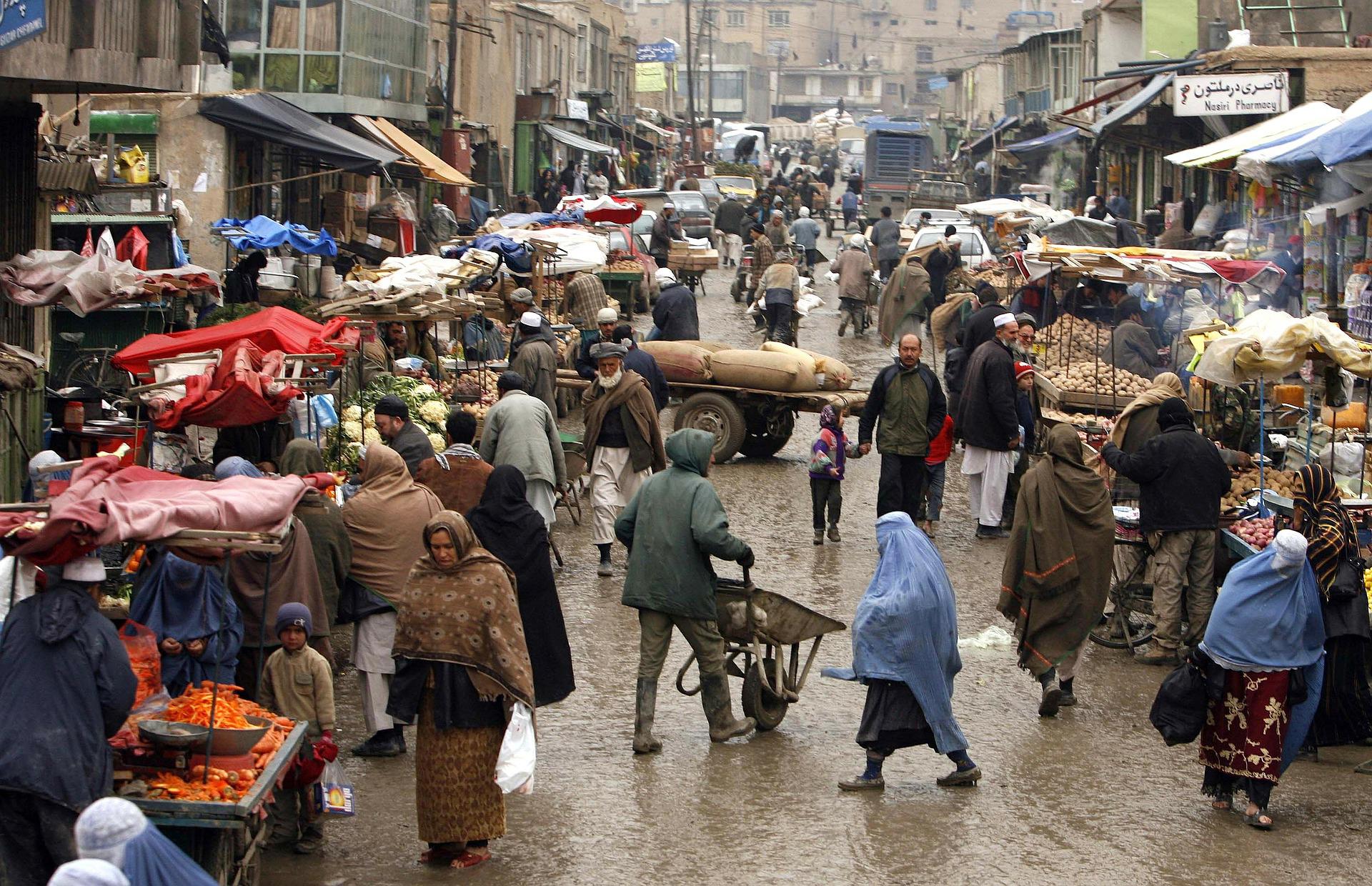
The dramatic shift of power in Afghanistan has been shocking and frightening, and it is still difficult to grasp what has really happened in such a short timeframe. At the Nansen Center for Peace and Dialogue we are deeply touched by these events and our thoughts and concerns go to all Afghans who live in rural communities, in cities and towns, and those who have left their homes for protection and live far away from their loved ones.
20 years of military presence commits
It is time for self-examination and renewed commitment from the international community. Twenty years of western military intervention has left Afghan citizens with broken hopes and unpredictability. We know there is a strong fear for the future, especially regarding rights for women, children, minorities, activists, and journalists.
It is our concern that Norway and the international community must stay committed to the Afghan people and not turn a blind eye under these extremely fragile conditions. Lines of communication must remain open, humanitarian aid continue and be strengthened, basic human rights ensured, and the most vulnerable individuals and groups need to be protected.
Demonstrating courage and resilience
Over the past years we have learned to know Afghans through cooperation with dedicated, hardworking colleagues and friends, particularly among the local staff of the Norwegian Afghanistan Committee (NAC), working in hard-to-reach communities. We are sincerely impressed by their commitment, resilience, and courage under unimaginable challenges.
Hopefully all that has been invested in trust building and dialogue within communities and with local Taliban leaders, will lay the foundation for meeting the needs of ordinary citizens by providing education, health, and security for all, including women, young people, and minorities. This requires, however, that fundamental human rights and security is maintained.
Dialogue on all levels
Under the current state of emergency, building peace from below may sound naive and unrealistic to some. However, the Nansen Center for Peace and Dialogue believes that in the long run, it may be the only way for communities to reconcile and build a peaceful future. At the Nansen Center for Peace and Dialogue we are committed to do what we can to assist our Afghan colleagues and friends in this work.
Dialogue on all levels is needed, from top level between international community and Taliban leadership to grassroot level within and between communities. Basic security and protection of rights is a prerequisite and needs to be guarded throughout the process. Therefore, it is of vital importance that diplomats and international humanitarian organizations return to Afghanistan and that the United Nations takes a stronger role to ensure continued commitment from the international community.
The value of dialogue in the civil society sector
Personal reflections after attending the Nansen Training Dialogue in Conflict.
By Kyle Naidu
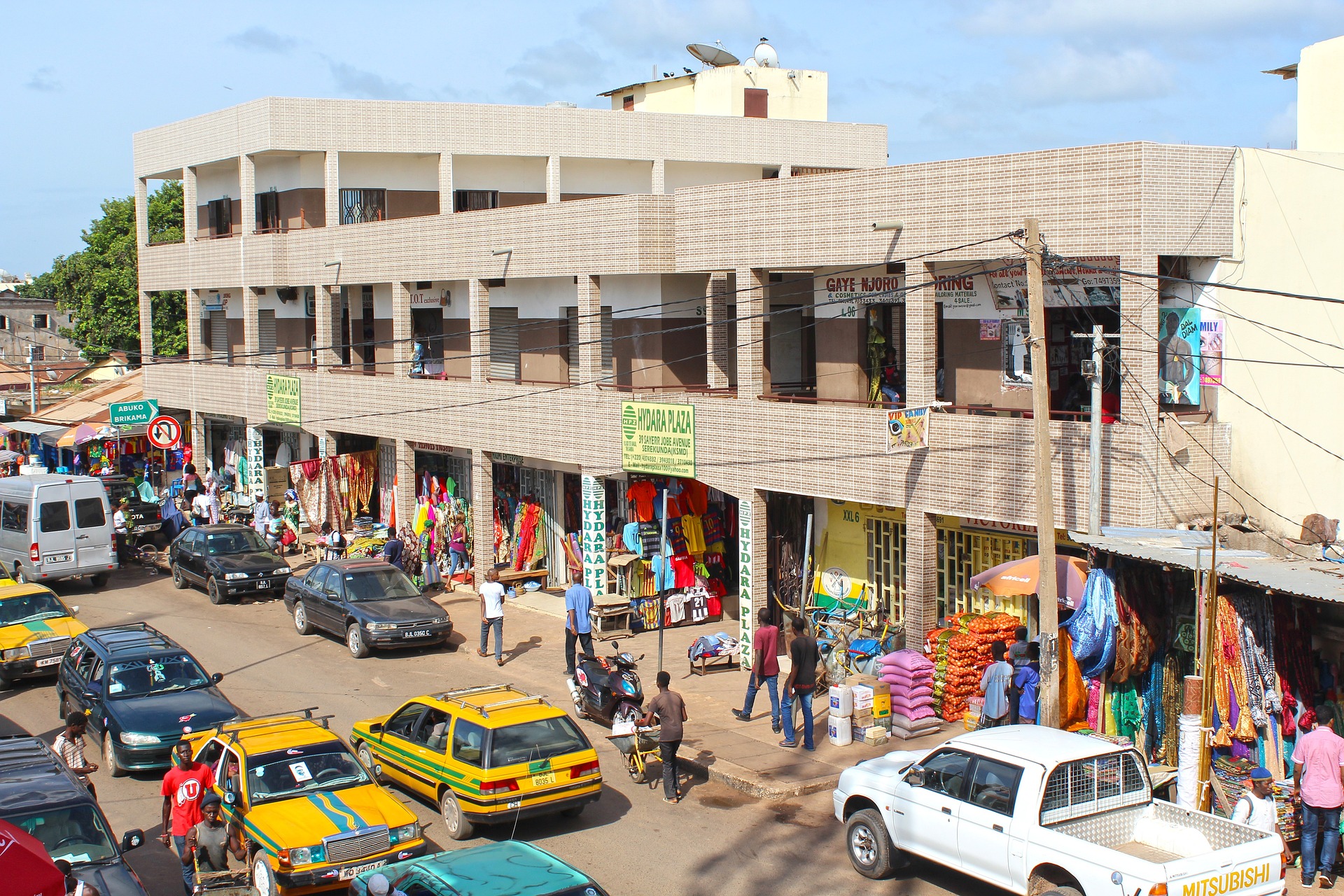
In 2017, as part of a Pan-African civil society delegation, I was sent on a solidarity mission to The Gambia in the wake of the previous year’s elections, resulting in incumbent president Yahya Jammeh refusing to step down from power. There was a fear of widespread violence, and thousands of people were fleeing across the borders into Senegal.
Days before the president-elect was to be inaugurated, we gathered and listened to civil society actors from all sectors: NGO’s, religious groups, youth groups, trade unions and many others. This was the only time these groups were brought together to take part in a conversation about the current state of their country. For the first time, they could sit down and listen to each other about their different approaches to stopping the country from slipping into a civil war.
After attending the Nansen Centre for Peace and Dialogue (NCPD) training on dialogue in November 2021, I was left thinking about the value of dialogue in my experiences with civil society, both internally and in relation to conflicts with the state.
Dialogue is necessary at all levels
The role that civil society can play in pre-conflict, during conflict and post-conflict situations is, I believe, invaluable. Civil society is often seen as a set of non-governmental entities that act as a counterbalance against the state. Alternatively, Mary Kaldor, a scholar on the subject of conflict and civil society, states that it is “the medium through which social contracts or bargains between the individuals and the centres of political and economic power are negotiated, discussed and mediated”.
Given the spaces civil society operate in, dialogue can be a decisive method to build trust, relationships, and understanding between the state and its citizens. This is because dialogue is an inclusive process that brings parties together to begin a process of understanding based on respect and openness. When communication breaks down, conflicts escalate, and more trust is needed to bring the parties back to the conversation. Moreover, the value of dialogue is not limited to conflicts between the state and the people. As a tool, dialogue is an integral part of building social cohesion at all levels of society and even within civil society itself.
The importance of communication in times of conflict
The training at the Nansen Center provided us with specific tools such as conflict mapping, conflict analysis and role play, but also an overall approach to dialogue. After the training I reflected upon the meeting with the Gambian civil society organisations and I still wonder what sort of progress could have been made if we were able to dig deeper into the positions, interests and needs of the stakeholders or even map out the conflict.
Although the meeting in The Gambia was not set up with a dialogical methodology, it did demonstrate that in times of conflict when communication comes to a halt, conversations that allow us to listen to each other’s perspective and positions are of great necessity.
Listening is necessary for a common understanding
I witnessed how the act of listening and understanding each other helped develop a more complete view of the efforts being undertaken by each group. In the end, the participants of the conversation left feeling energised, and an air of camaraderie was felt by many as they came together in a mutual understanding. The participants went on to combine their efforts and launched an SMS task force aimed at sending mass cell phone messages to military higher-ups to stand down and respect the election results. The Gambia is a small nation, so it only took a moment to find someone at the meeting with a cousin who had a general’s phone number.
Having worked extensively with civil society across Africa, it is clear to me that dialogue can be a vital tool in stemming some of the misunderstandings that often happen between state entities and CSO’s, but also amongst CSO’s themselves.
Unveiling the needs and interests beneath the surface
Within grassroots movements and civil society organisations in general, we are often used to conducting our meetings and operations with a slightly argumentative rhetoric. This can include systems such as internal voting, debates, agenda-setting and even as we identify the goals of our organisation. We often spend little to no time further understanding the interests and needs that lie beneath the surface of our outward-facing positions as we focus more on our deliverable or servicing our community.
A dialogical approach to running an organisation or movement can allow for a broader and deeper understanding of the problems that face the organisation or community and elucidate more effective ways of implementing ideas through the inclusive process of dialogue.
Conflicts are a part of life
We all encounter misunderstandings, conflicts, divisions, or disagreements in our lives. Some of these realities remain on a manageable level, and we often manage them unconsciously. Other times, these natural processes become escalated and difficult to navigate or manage. As John Paul Lederach, one of the foremost thinkers in the field of peacebuilding, states, “conflict is continuously present ”, but it must be managed to ensure that the worst outcomes are avoided. The same can be said for conflicts between groups at all levels of society.
Civil society actors like myself need to embrace dialogue as a tool to better understand ourselves, the people we aim to serve, and those that we are critical of. Moreover, we should recognise that its value is not only limited to conflict but should sink into the very core of our functions.
As we touched upon in the training, conflict is not inherently bad; however, if neglected, conflicts often become untenable, and the harmful aspects of conflict can begin to take root. Therefore, the need for understanding becomes imperative to mitigate conflict escalation.
That is where dialogue can be a tool for peace.
Naidu is a South African grassroots peacebuilder, conflict resolution practitioner and researcher with experience working with civil society and activists from across Africa. Naidu holds a master’s degree in Advanced Peacebuilding and Conflict Resolution from the University of Bradford and attended the Nansen training – Dialogue in Conflict in November 2021.